by Dan Harrel | Dec 17, 2014 | Popular Articles
Why Should a Child Study Music?
Music is a Science
It is exact, specific, and it demands exact acoustics. A conductor’s full score is a chart, a graph that indicates frequencies, volume exchanges, melody, and harmony all at once and with the most exact control of time.
Music is Mathematical
It is rhythmically based on the subdivisions of time into fractions that must be done instantaneously not worked out on paper.
Music is a Foreign Language
Most of the terms are in Italian, German or French, and the notation is certainly not English – but a highly developed kind of shorthand that uses symbols to represent ideas. The semantics of music is the most complete and universal language.
Music is History
Music usually reflects the environment and times of its creation often even the country and/or racial feeling.
Music is Physical Education
It requires fantastic coordination of fingers, hands, arms, lip, cheek and facial muscles, in addition to extraordinary control of the diaphragmatic, back, stomach, and chest muscles, which respond instantly to the sound the ear hears and the mind interprets.
Music is all these things but most of all, Music is Art
It allows a human being to take all these dry, technically boring (but difficult), techniques and use them to create emotion. That is one that science cannot duplicate: humanism, feeling, emotion, call it what you will.
That is why Music should be studied-
Not because the child is expected to major in music
Not because the child is expected to play or sing always
Not so the child can relax
Not only so the child can have fun
But –
So the child will be human
So the child will recognize beauty
So the child will be sensitive
So the child will be closer to an infinite beyond this world
So the child will have something to cling to
So the child will have more love, more compassion, more gentleness, more good – in short, more life
Of what value will it be to prepare the child to make a prosperous living unless the child also learns how to live?
That is why Music should be studied.
Reprinted with the permission of PMEA News,
Official publication of the Pennsylvania Music Educators Association
by Dan Harrel | Dec 17, 2014 | resources
Selection and Care of your Instrument
by Rosemarie Klimasko – August 2009
If you are purchasing a new or used instrument, it is crucial that you seek the advice of your home
studio teacher. Your teacher will be more than willing to help you find an instrument that is competitively priced and suitable for the playing level of your child. NEVER purchase an instrument unless your teacher has seen, played and checked the instrument.
Stringed instruments are acoustic, made of wood, thus you must take care not to expose them to extreme and sudden changes of temperature. Heat is more destructive than cold, so do not leave your violin in a car on hot days. Direct sunlight can soften the wood glues used by luthiers, weakening or destroying the joints in the instrument. In cold weather, simply ensure that the violin has some insulation if it is to be in the cold for any length of time.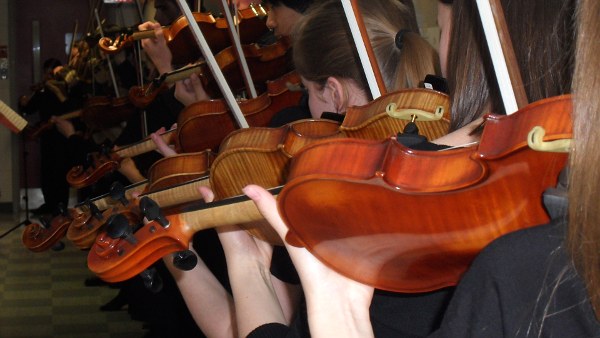
Avoid storing instruments in damp areas, which can cause the instrument to warp around the neck area.
Dry conditions, especially in Ottawa, are the worst culprit in creating cracks and as well as opening seams on your instrument. This may result in expensive repair work, especially in older instruments. Keep your instrument beside a humidifier or purchase a Dampit which is inserted into the F hole of your violin.
Slacken the hairs of the bow when not in use (your teacher will show you how to do this) to avoid warping the bow and thereby losing the curve and tension of this delicate piece of wood. Avoid touching the hairs of your bow. Natural oils on your hands will spoil the ability of rosin to adhere to the hairs of the bow. Always purchase a fine quality rosin, even for beginners. It will cost you about eight dollars, and, if handled carefully, will last for several years.
Clean the rosin off your violin and bow with a soft, dry cloth after you practice. Two or three times a year, your violin will need a nice polishing. NEVER use a furniture polish, as this will ruin the varnish. Invest in a high quality cleaning product used specifically for stringed instruments. A small bottle will last you for several years and several drops, with some buffing, will do the job.
If changing strings, never remove or change all at once; as this could cause the soundpost inside the instrument to collapse, obliging you to make an unplanned visit to your local repair shop. Have your teacher show you how to change strings if an emergency should arise. Violin pegs can expand in summer or contract in winter, making them difficult to turn (if they expand) or harder to keep in place (if they contract). This is to be expected and can be rectified by purchasing “peg paste” to create the friction needed to hold the peg in place.
Do not attempt to do any home repairs. Your teacher can direct you to someone who is qualified to do the necessary repair work. And finally, always carry an extra set of strings in your case; they have a tendency to break at the most inopportune times!
by Dan Harrel | Dec 17, 2014 | Uncategorized
Notes for Parents about the “Parent’s Daily Dozen” practice chart
(see Daily Dozen practice charts at bottom of page)
by Stephanie Judy
The “Parent’s Daily Dozen” practice chart was developed in response to a discussion in 2001 on the Suzuki-Chat e-mail list about what teachers can do to help parents gain better skills at being a practice coach or “home teacher.” One parent—who was in considerable distress at that moment—said that she wished there was a practice chart for parents. Bingo! The idea was born. Vicky Barham of Ottawa and I volunteered to draft a parent’s practice chart, and this is the result. After being discussed and revised via Suzuki-Chat, it was tested at various Suzuki Institutes and in several teachers’ studios, with both teachers and parents reporting that it was useful.
I would like to ask you to use this chart for 8 weeks. During the “parent time” in group class, we’ll discuss how it’s working for you. The spaces under each item are for you to jot down any comments, questions, or reminders to yourself. There’s a streamlined version (without the extra spaces), that I’ll give you after you’ve used this one for two or three weeks.
Some general notes about practicing
For most children younger than about 12, taking music lessons and learning to play an instrument is primarily the parent’s commitment.
Some children are enthusiastic, some are not. No child is aware of the challenges ahead. Every child needs the parent’s consistent, loving support to meet those challenges day after day.
The first year is the hardest. You may encounter some rocky times—you may even regret that you got started! Hang in there! If things get really rugged, phone me or phone an experienced parent to get some ideas and encouragement. During the first year, we are not so much teaching the child how to play the violin as we are teaching the parent to understand how your child learns . . . not how children in general learn, but how your own child learns best.
In Suzuki violin practice, the relationship of the parent to the child is very much like the parent/child relationship in learning to cross a street. At first, the parent has total responsibility, and the child has none—the child simply goes along for the ride, in arms, in a stroller, or in a backpack. Gradually, however, the child begins assuming more and more “street-crossing” responsibility—first by holding the parent’s hand instead of being carried, and then by walking beside the parent without holding hands. At some point, the child learns to look for cars and helps decide when it’s safe to cross, and so forth. As the years go by, the parent very gradually relinquishes responsibility to the child.
Violin practice is the same way. You will “carry” your child for a long time—maybe weeks, maybe months, maybe years. You will see to it that the practice happens and you will ensure that the environment is positive, (although you can certainly enlist your child’s help). If you and I do our jobs well, then, little by little, your child will take over responsibility. By the time your child is 12 or 13, he or she will likely be practicing independently, and—I can promise you this—you will look back and feel that it was worth the effort.
Some specific notes about the “Parent’s Daily Dozen”
Please let your child hear the Suzuki book level recording a minimum of three times each day (about an hour in total). Daily listening is the single factor that is most strongly correlated to a student’s success in a Suzuki program.
Make practicing a routine event that happens at the same time every day. Pick a time when your child is reasonably alert but also calm. In most families, it’s best to set a practice time as early as possible in the day so that if it doesn’t happen, you still have time left in the day to do it. It’s also a good idea to tie practicing to another inevitable daily event—“After lunch, we practice.” The hardest part of practicing is getting the violin out of the case and making it ready to play. Find a special corner of your house where you can keep the things you need—violin, Suzuki book, your notebook, music stand, music dictionary, electronic tuner, metronome, whatever “gear” you use. You will be spending a lot of time in this space, so make it inviting and special: add a vase of flowers or put up some photos of composers and violinists–including your child!
Before the practice starts—earlier in the day, if you can—jot some notes about what you plan to accomplish. If it helps you to use a practice task chart (for your child), by all means do so.
Children often dislike changing from one activity to another. A bit of warning helps smooth the way: “In 10 minutes, it will be time to practice. Find a stopping place in your book/game/puzzle.”
If you aren’t in the habit of bowing to begin and end your practices, it may feel awkward or unnatural the first few times. That’s OK. Just do it anyway. If you have any questions about why Suzuki students bow to their teacher and their parent, please ask me.
A parent’s attention is a precious commodity for a child. Practicing together gives you an opportunity to offer undivided attention to your child every day. Your child will take cues from you about the value of practicing. If you give it only a quarter of your attention, your child is not likely to develop much commitment to it, either. (Use common sense, of course. You’re not expected to ignore the urgent needs of a younger sibling or let a pot boil over!)
The key word here is effort. You are acknowledging effort—not achievement. (Achievement will come through effort, and never without it). You can show appreciation non-verbally by smiling, nodding, giving a “thumbs up,” applauding, tapping your foot or swaying in time to your child’s music, or closing your eyes and listening intently.
This is the real key to productive, contented practices. Your child is working hard and, at times, really struggling. He or she will get discouraged and frustrated from time to time. Your child has a limited understanding of the process; you are the adult, and are able to take a longer view. A “one-point practice” means that you focus on one thing at a time. Avoid, for example, saying, “That was pretty good but your wrist was bent and the C# was too low and your pinky was straight on the bow and you’re supposed to use stopped bows and you forgot to play the repeat.” OVERLOAD! Instead, pick the one thing that will make the most difference in the child’s playing. This may well be something that was emphasized in the lesson. If you’re not sure what to focus on, start at the top of this list and work down: (1) balanced playing position, (2) beautiful tone, (3) perfect intonation.
Many children get frustrated when they feel that they don’t have any control over the situation. Give your child every choice that you reasonably can. She doesn’t get to choose whether or not to practice, and whether or not to play F# in tune, but she can choose which review piece she wants to play first, and whether she’d like to do scales at the beginning or end of the practice.
Any time you are focussing on tone—on the beauty of the sound—you are practicing tonalization. I will usually assign a specific practice for tonalization.
Book 1 students review every piece every day. I’ll give review lists to students in Book 2 and up.
As often as possible, end the practice when the child is happy and enthusiastic, or end it with something the child especially likes to do.
The last two items on the chart are for you and your child to summarize the day’s practice. You can use this space in any way you like. You might want to rate the practice on a scale from 1 to 10, or give 1 to 5 stars (like a movie review). The space for your child’s comment is extra big, so that your child can draw a happy face, put on a sticker, or write a few words—whatever seems appropriate.
The Daily Dozen Charts:
Daily Dozen
Daily Dozen2 – (streamlined version)
by Dan Harrel | Dec 17, 2014 | Popular Articles
Note: Ottawa Suzuki Strings policy is that lessons missed by the student are not made up.
Make-up Lessons From An Economist’s Point of View
I’m a parent of children enrolled in Suzuki music lessons. I’d like to explain to other parents why I feel – quite strongly, actually – that it is unreasonable of we parents to expect our teachers to make up lessons we miss, even if I know as well as they do just how expensive lessons are, and, equally importantly, how important that weekly contact is with the teacher to keeping practicing ticking along smoothly. I think that it is natural for we parents to share the point of view that students should have their missed lessons rescheduled, but if we were to ‘walk a mile’ in our teachers’ shoes, we might change our minds about what it is reasonable for us to expect of our teachers.
Like many parents, I pay in advance for lessons each term. In my mind, what this means is that I have reserved a regular spot in the busy schedules of my sons’ teachers. I understand – fully – that if I can’t make it to the lesson one week (perhaps my son is sick, or we are away on holiday, or there is some other major event at school) then we will pay for the lesson, but that my teacher is under no obligation to find another spot for me that week, or to refund me for the untaught lesson. And this is the way it should be.
In my ‘other life’ I am an economist and teach at our local university. Students pay good money to attend classes at the university; but if they don’t come to my lecture on a Monday morning, then I am not going to turn around and deliver them a private tutorial on Tuesday afternoon. When I go to the store and buy groceries, I may purchase something that doesn’t get used. Days or months later, I end up throwing it out. I don’t get a refund from the grocery store for the unused merchandise. If I sign my child up for swimming lessons at the local pool, and s/he refuses to return after the first lesson, I can’t get my money back. So there are lots of situations in our everyday lives where we regularly pay in advance for goods or some service, and if we end up not using what we have purchased, we have to just ‘swallow our losses’. On the other hand, if I purchase an item of clothing, and get home and change my mind, I can take it back and expect either a refund or a store credit.
So why do I believe that music lessons fall into the first category of ‘non-returnable merchandise’, rather than into the second case of ‘exchange privileges unlimited’ (which I think is one of the advertising slogans of an established women’s clothing store!)? Speaking now as an economist, I would claim that the reason is that items like clothing are “durable goods’ – meaning, they can be returned and then resold at the original price – whereas music lessons are non-durable goods – meaning, once my Monday slot at 3:30 is gone, my son’s teacher can’t turn around and sell it again. The only way she would be able to give him a lesson later in the week would be if she were to give up time that she had scheduled for her own private life; and that seems pretty unreasonable – I can’t think of many employees who would be thrilled if their bosses were to announce that they couldn’t work from 3:30 to 4:30 this afternoon, but would they please stay until 6:30 on Thursday, because there will be work for them then!
Many teachers hesitate to refuse our request to shift lesson times (because our busy schedules do change), because unless they keep us parents happy, we will decide to take our child somewhere else for lessons (or to drop musical study), and they will lose part of their income. This is particularly true in areas with lower average income, where it can be particularly difficult to find students. So rather than telling us that ‘well, actually, the only time when I’m not teaching and that you can bring your son for lesson is during the time I set aside each week to go for a long soul-cleansing walk, and I can’t do that on Monday at 3:30 when you should have turned up’, they agree to teach us at a time that really doesn’t suit their schedule. Teachers who are ‘nice’ in this way often, in the long run, end up exhausted, and feeling exploited; they try to draw a line in the sand. However, too few parents ask to switch only when absolutely necessary, and too many parents want lesson times when it suits them this week, which is not the same time that suited last week. If the conflict arises because my child is in the School play, and they have their dress-rehearsal during his lesson time, then I feel that I must choose between the two activities, and if he attends the dress rehearsal my private lesson teacher doesn’t owe me anything.
During May, my eldest son will be missing three lessons because he is going to accompany me on a trip to New Zealand to visit his great-grandparents. I do not expect my son’s teacher to refund me for those missed lessons, or to reschedule them by ‘doubling up’ lessons in the weeks before or after our departure. Since there will be lots of advanced notice, I might ask her to consider preparing a special ‘practice tape’ for that period, or to answer my questions via e-mail, but if she doesn’t have the time (the second half of April is going to be really busy for her, and she wouldn’t be able to do the tape until more or less the week we left) and so has to refuse, then that’s fine. I certainly don’t expect her to credit me with three make-up lessons; there is no way for her to find a student to fill a three-week hole in her schedule during our absence. Instead, I hope that she will enjoy the extra hour of rest during those three weeks, and that we will all feel renewed enthusiasm when we return to lessons at the end of the trip.
Article Copyright © 2001 Vicky Barham
by Dan Harrel | Dec 17, 2014 | Uncategorized
Finding the Right Teacher
You have decided that you want to offer your child the gift of music…and now you need to find a teacher.
 You want a good teacher. But how can you tell a good teacher from a bad one?…And what is a good teacher?
There are lots of good teachers, and lots of bad ones. As a parent, however, your goal should be to find the right teacher – the one who will work effectively with your child, and whose vision for your child’s musical future is one that you share. Below are some issues that you need to consider in determining whether or not a particular teacher is the right teacher for your child.
What are the teacher’s priorities: is music to be a fun activity, or is the goal to learn to play beautifully?
No teacher wants the study of music to be an unrelentingly unhappy experience for their students.
Nor do they aspire to make music 100% fun but for their students not to learn to play the instrument. Although lots of games make things fun and easy for beginning students, the truth is that learning to play an instrument – particularly a string instrument – is challenging.
In the medium term, students are successful only if the teacher and the parent are persistent in pursuing well-defined goals and put in the effort needed to develop their technical skills. For making music to truly be fun, the child needs to feel confident about their playing skills. Very, very few children have the potential to become musical prodigies…but, with the right teaching, and the right home learning environment, all children can be encouraged to achieve personal excellence and can learn to play well.
How can I tell whether a teacher is effective?
Ask to attend a recital where the teacher’s students are performing. Are most of the students able to perform their pieces without obvious difficulties, or are there many students who hesitate or stop playing? Does it sound as though they are playing in tune? Is the sound pleasing to the ear, or is it unattractive? Do some of the students look like professionals? Do they look happy to be performing?
Ask to observe some lessons – preferably of children near in age to your child. Watch the relationship between the teacher and the different students: to what extent does the teacher adjust their approach to reflect the differences between the students? Is the teacher able to explain what is expected in a way that the child can understand? Is the child engaged in the lesson? Would this approach suit your child?
Ask if students in the teacher’s studio participate in local music festivals, or take exams. Teachers whose students participate in music festivals typically use these events as an opportunity to encourage their young protégés to reach for the very highest standard of playing they can achieve. It is highly motivating for some students to discover just how well they can perform their repertoire, and the feedback from the adjudicator is always very helpful.
Are there any special things that I should look for with a Suzuki teacher?
A key part of the Suzuki approach to learning is the emphasis on listening to reference recordings,  review, and the involvement of parents. If you are studying with a ‘Suzuki’ teacher, and you are not expected to be listening to the recordings of your current , future and past repertoire…then there is something wrong. If you are not – particularly until you get to the Book 6 level – expected to regularly review your past repertoire, then your child is not going to achieve the same level of mastery as will the students of other Suzuki teachers. If your teacher does not expect you to attend all of your child’s lessons, to take notes, and to practice daily with your child, then your child is studying with a traditional teacher who uses Suzuki repertoire. A Suzuki teacher will expect you to work with them, as their partner, and will take the time during the lesson to make sure that you understand the practicing assignments, and will make sure that you have the time to ask questions. A good Suzuki teacher will will be happy to discuss strategies for dealing with problems you encounter on your musical journey.
Why shouldn’t I just go to the teacher who is closest to me?
Music lessons are expensive, both in terms of time and of money. In addition to lessons you have to buy/rent an instrument, and music books. You are going to be practicing every day with your child, probably for half an hour per day (with younger students). And you have to attend private and group lessons.
You want to make sure that you get the best possible return on this investment. That means choosing a teacher who will work effectively with your child. You might save 20 minutes a week in travel time if you study with the teacher closest to you…but in the overall scheme of things, that’s not much of a savings.
Make the effort to take your child to a lesson at a time of day when your child is best able to learn. Young children do not learn best in the evenings, or after a full day of school. If your child is an early riser, then you should move mountains to schedule a day-time lesson…preferably in the morning. If your child likes to sleep in, then schedule a day-time lesson…in the afternoon. Although it can be difficult to organize work schedules to accommodate a day-time lesson, there are huge payoffs: going to the lesson is a special time that you spend each week with your child, and your child will be able to fully engage with the teacher in the lesson, ensuring that the learning experience is successful, and that they make more rapid progress in learning how to play the instrument.
If there is absolutely no way that you can get accommodation from your office to enable you to take your young child to a day-time lesson, then make sure that your child gets a proper snack before the lesson, and try to create a calm, positive atmosphere on the trip to the lesson. You will have to accept the fact that, some weeks, your child will simply be too tired to really do their best, and when that happens it may be best to cut the lesson short. As you wait for your child’s stamina to increase, you may want to consider sharing the lesson time with your child, and learning how to play the instrument yourself: this will help you to appreciate how difficult it is to learn to do what is required, and what an amazing learner your child is.
